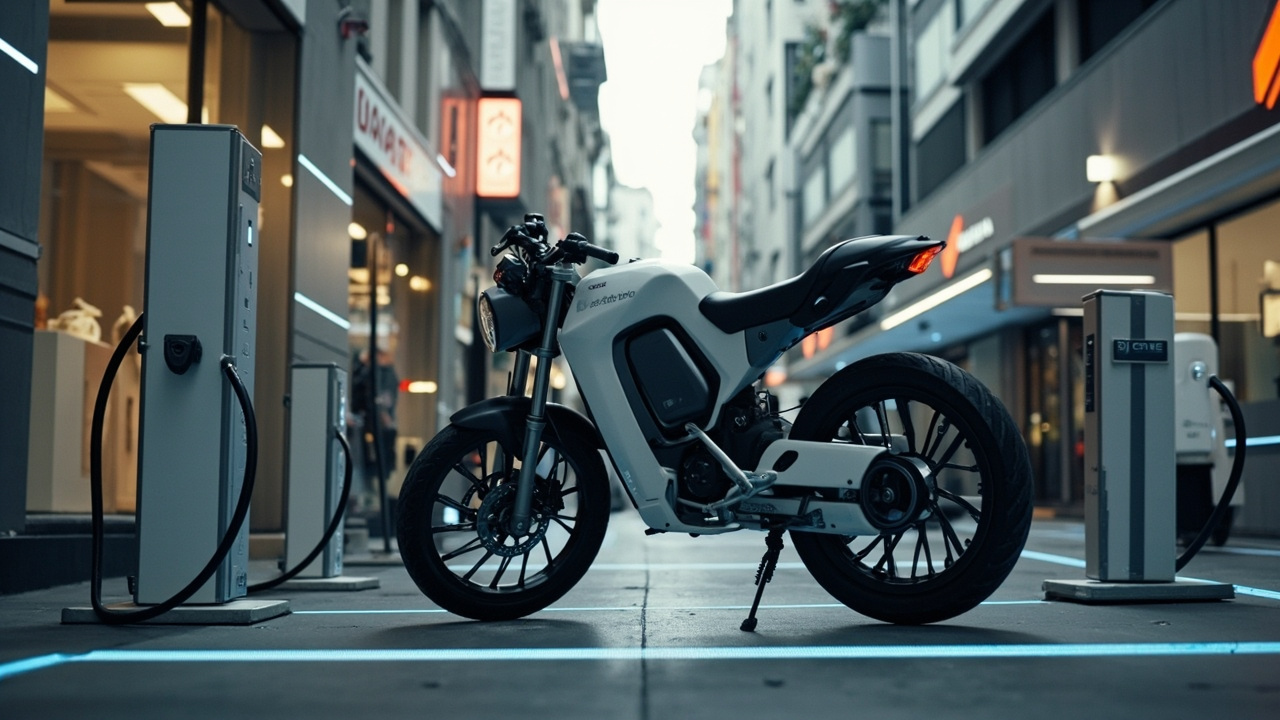
Electric Motorcycles
The history of electric motorcycles can be said to be as long as that of internal-combustion motorcycles. In fact, the world's first practical motorcycle did not use a gasoline engine but was electrically driven. In the early 1900s, because gasoline engines had poor power output and low reliability, electric motorcycles were briefly popular.
In 1912, the American magazine Motor Cycling reported performance test results for electric motorcycles of the time. The product, made by India Electric Cycle Company, used replaceable storage batteries and had a maximum range of about 100 miles. This figure was already quite impressive at the time.
However, beginning in the 1920s, gasoline engine technology advanced rapidly and costs fell sharply. Electric motorcycles gradually left the market because they were too expensive and had limited range. This situation lasted for more than half a century, until rising environmental awareness and breakthroughs in battery technology put electric motorcycles back on a fast track of development.
In 2006, Zero Motorcycles was founded in the United States and became the first modern electric motorcycle manufacturer with scaled mass-production capability. The Zero S launched by the company was a sport motorcycle using chain drive, with a maximum range of about 180 kilometers. In 2010, Triumph's parent company ific Group also entered the field and launched a road-legal electric scooter.
In 2011, Taiwan's Gogoro was founded and adopted a completely different business model. Gogoro does not simply sell motorcycles, but provides vehicles and battery-swapping services through a subscription model. Users pay a monthly fee to use the motorcycle and replace depleted batteries with fully charged ones at Gogoro swap stations. This model greatly reduces the consumer's initial burden and solves the problem of long charging times. Gogoro's battery-swapping system has deployed more than 1,000 stations in Taiwan and has become the world's largest motorcycle battery-swapping network.
In 2013, Canada's Evoke Motorcycles was founded, focusing on the development of high-performance electric motorcycles. The company's Evoke 6061 is a sport model with an aluminum alloy frame and mid-mounted motor. It accelerates from 0 to 100 kilometers in only 3.1 seconds, with performance beyond comparable traditional internal-combustion models.
In Asian markets, electric motorcycles have developed especially quickly. China's Niu Technologies is the Xiaoniu electric vehicle brand, known for smart electric motorcycles. Its products include GPS tracking, smartphone app connectivity, cloud data analysis, and other features, successfully entering the urban commuting market. India's Ather Energy has also developed rapidly, launching the 450X series of smart electric motorcycles with touch dashboards and OTA update capability.
Traditional major motorcycle manufacturers have also entered electrification. Harley-Davidson launched LiveWire in 2019, the company's first mass-produced electric motorcycle. LiveWire uses a larger-diameter DC fast-charging port and can charge to 80% in 45 minutes. BMW's CE04 went on sale in 2022. This avant-garde scooter uses an automotive-grade powertrain and safety equipment.
Electric motorcycle technology continues to advance. Solid-state batteries are regarded as a key next-generation technology. Their energy density is expected to be several times higher than existing lithium-ion batteries, and charging times will also be greatly shortened. Many organizations are actively developing solid-state battery technology, which is expected to enter commercialization in the late 2020s.
Range anxiety is one of the main factors hindering the adoption of electric motorcycles. Most current products have ranges between 150 and 250 kilometers, which remains insufficient for long-distance travel or delivery services. Building fast-charging infrastructure is the key to solving this problem. Charging-station construction is currently moving fastest in Asia, while public charging networks in North America and Europe are also expanding rapidly.
Policy support is an important driver of electric motorcycle adoption. Government subsidies in Taiwan make electric motorcycles such as Gogoro price-competitive. Many cities in mainland China have implemented policies restricting traditional motorcycles while offering preferential treatment to electric motorcycles. Increasingly strict carbon-emission standards in European countries have also pushed traditional motorcycle manufacturers to accelerate electrification.