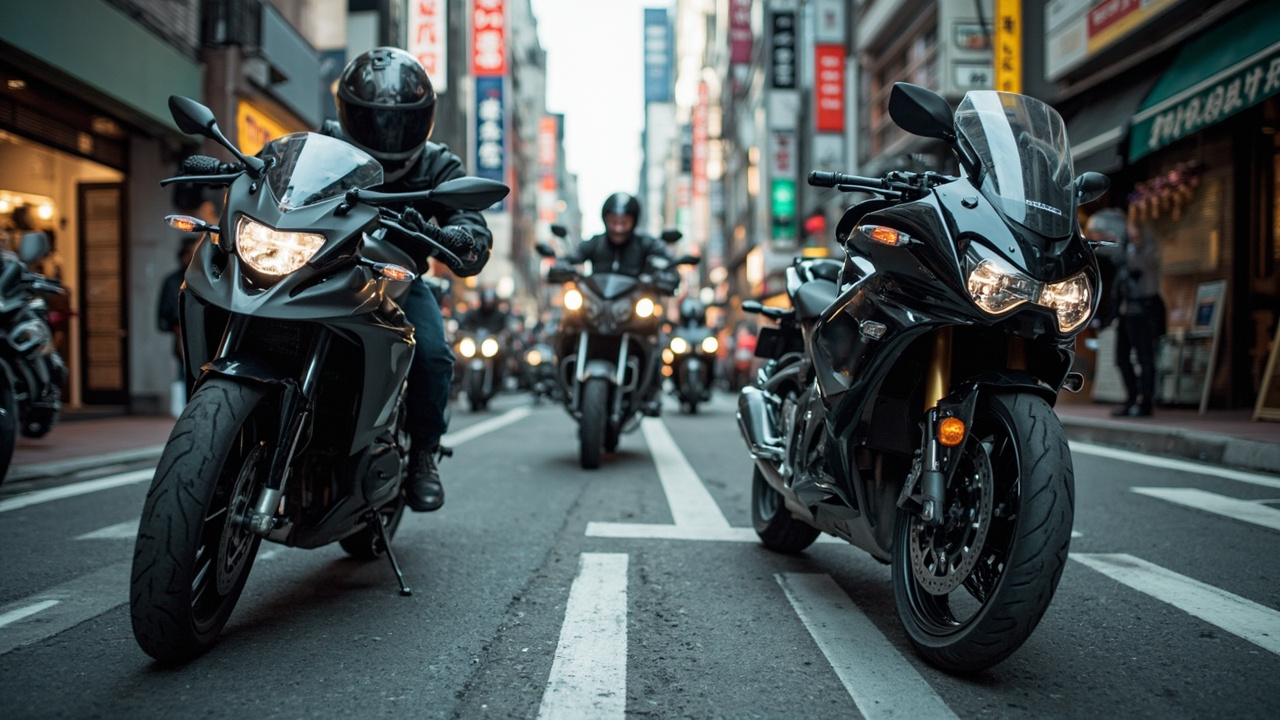
Japanese vs European Motorcycle Culture
Japanese and European motorcycle cultures represent two very different development paths and value orientations. Their differences are reflected not only in motorcycle design and engineering, but more deeply in different historical backgrounds, social needs, and aesthetic ideas.
The core characteristics of Japanese motorcycle culture are practicality and efficiency. In the 1960s, when Japan's motorcycle industry began entering the global market, it adopted a strategy of low price and high quality. Products from the four major manufacturers—Honda, Yamaha, Suzuki, and Kawasaki—quickly captured the market with reliable quality and approachable prices. For postwar Japanese society, where materials were scarce, motorcycles were first and foremost transportation rather than toys. This practical starting point deeply influenced the tone of Japanese motorcycle culture.
Japanese motorcycle design emphasizes the combination of high performance and low maintenance cost. This orientation produced classics such as the Honda CB750, a large motorcycle with a four-cylinder engine, advanced braking system, and reasonable price that completely changed global perceptions of motorcycles. After that, Japanese manufacturers continued investing in technological innovation and became leaders in modern motorcycle engineering.
European motorcycle culture, especially in Italy and Britain, has a completely different tradition. European motorcycle culture began in an era of personal transportation needs, but it quickly became closely connected with fashion and art. Italy's Vespa and Lambretta scooters were not only transportation tools but also symbols of the revival of Italian society and youth culture in the 1950s.
In Britain, the close connection between Cafe Racer culture and motorcycle sport created a distinctive subculture. Motorcycles were seen as tools of individual expression, and riders were passionate about modification and customization. British manufacturers such as Triumph, BSA, and Norton produced models with strong individual style and handmade character, forming a sharp contrast with standardized Japanese mass-produced products.
German motorcycle culture emphasizes engineering quality and craft tradition. BMW's horizontal boxer engine design and Porsche's shaft-drive system represent Germany's pursuit of technical perfection. The existence of Germany's Autobahn unrestricted highways also made high-speed cruising an important element of German motorcycle culture.
Although French motorcycle culture is smaller in scale than that of other European countries, it has its own development path. In the 1970s, the French government strongly promoted small motorcycles to solve urban traffic problems. Although the policy ultimately failed, it gave rise to a distinctive "cyclo" culture. In recent years, France's custom motorcycle scene has begun receiving international attention, especially in handmade exhausts and custom frame fabrication.
The exchange and integration of Japanese and European motorcycle cultures is an important trend in modern motorcycle development. Beginning in the 1980s, Japanese manufacturers hired European designers to help develop products for mature markets. Honda's NR750 and Yamaha's RZ1 were products of this cultural fusion. Entering the 21st century, BMW and Ducati were successively acquired by Indian and German companies, making globalized management the norm.
This integration is also reflected in rider culture. Many Japanese riders have become fascinated by the aesthetics of Italian design and collect classic Ducati and MV Agusta models. At the same time, European riders have begun to appreciate the reliability and high performance of Japanese motorcycles. This cross-cultural appreciation has promoted the unity of global motorcycle culture, but it has also gradually blurred local characteristics.
Racing also reflects these cultural differences and integrations. Japanese manufacturers have invested heavily in MotoGP and World Superbike, training many top riders. Europe is the home of traditional endurance races and street races; the French 24 Hours of Le Mans and the Isle of Man TT are both classic events with long histories.
Overall, Japanese and European motorcycle cultures represent two orientations: pragmatism and romanticism. The former values function, efficiency, and technological innovation; the latter emphasizes tradition, craftsmanship, and cultural depth. The interaction and integration of these two cultures continues to drive the evolution of global motorcycle culture.