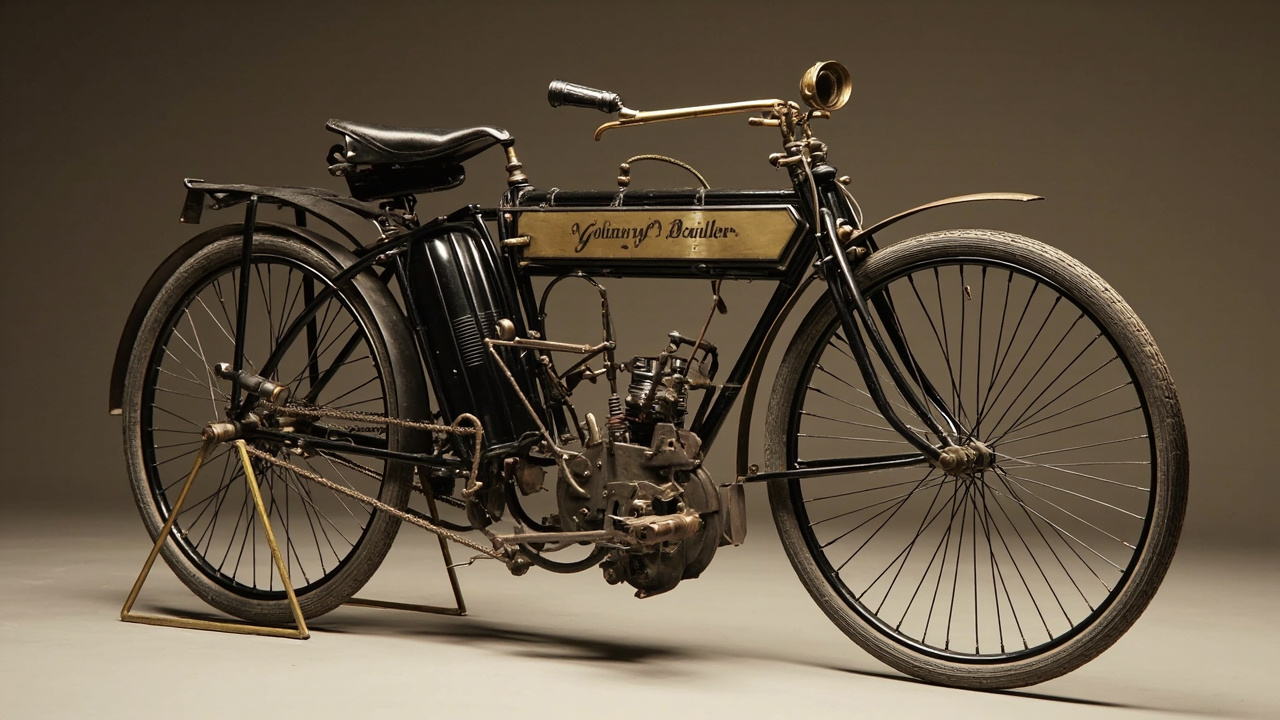
The Birth of the Motorcycle
The history of the motorcycle can be traced to the late nineteenth century. In 1885, German engineers Gottlieb Daimler and Wilhelm Maybach developed the world's first true motorcycle, named the "patent motorcycle" (Reitwagen). This single-cylinder, four-stroke vehicle used a wooden frame and could reach a speed of twelve kilometers per hour. Notably, this pioneering machine used a central engine layout, with the cylinder placed horizontally in the middle of the frame, while power was transmitted directly to the rear wheel by belt drive.
During the same period, France's Butler and Britain's Edward Butler each developed three-wheeled motor vehicles. In 1887, Butler's three-wheeled passenger vehicle used a steam engine, but its large size prevented practical use. In 1894, Germany's Hildebrand and Wolfmuller brothers introduced the production motorcycle "Hildebrand," using a water-cooled twin-cylinder engine with each cylinder displacing 1492cc. It became the world's first motorcycle available for purchase.
From the late nineteenth century to the early twentieth century, engineers across Europe and America entered motorcycle development. Britain's Eagle Motorcycle Company, America's Indian and Harley-Davidson, Germany's NSU and Bosch, and Italy's Bianchi and Gilera all built foundations during this period. In 1901, American Motorcycle Company was founded and introduced its first motorcycle in 1903. In the same year, Indian introduced the single-cylinder ighthorse motorcycle, which led its peers in performance.
The evolution of engine technology was central to motorcycle development. Early motorcycles mostly used simple single-cylinder air-cooled engines, with displacements ranging from several dozen cc to several hundred cc. In 1902, Italy's Gilera introduced a V-twin engine design, greatly improving power output. Thereafter, technologies such as chain drive, spring front forks, and drum brakes matured one after another, laying a solid foundation for motorcycles to become practical vehicles.
In 1901, Britain's Rover introduced a three-wheeled motorcycle with a four-stroke engine, regarded as one of the prototypes of the modern motorcycle. During the same period, France's Peugeot and Derby developed lighter steel-tube frames, reducing vehicle weight while improving rigidity and durability. These technical breakthroughs gradually transformed the motorcycle from an experimental product into a reliable means of transportation.
By the mid-1900s, motorcycles had become important personal transportation in Europe and America. Urban development and the expansion of road networks created favorable conditions for motorcycle adoption. Manufacturers began focusing on reliability and durability rather than simply pursuing ultimate performance. This pragmatic development direction allowed motorcycles to continue playing an important transportation role over the following decades.