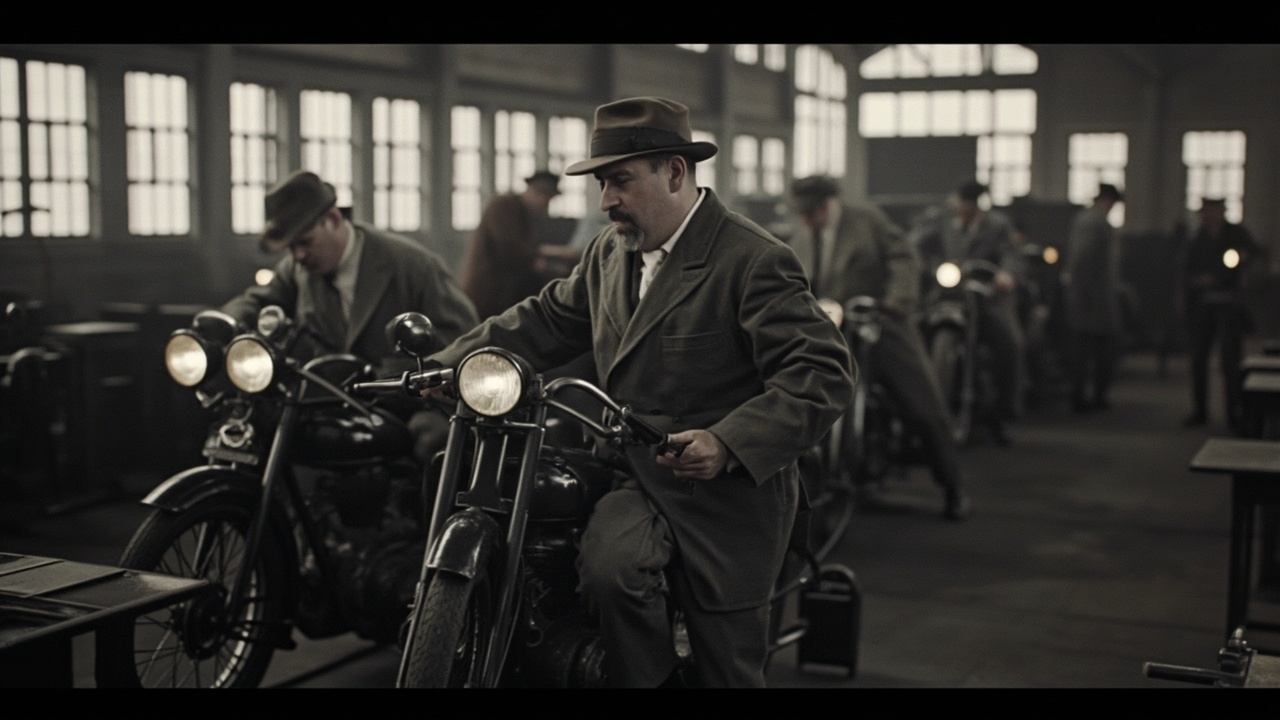
The Great Depression and the Motorcycle Industry
The Wall Street stock market crash of October 1929 triggered the global Great Depression. This most severe economic crisis in history dealt a devastating blow to the motorcycle industry. From 1929 to 1933, global motorcycle sales fell by more than 70 percent, many manufacturers went bankrupt, and the industry's competitive landscape was dramatically reshuffled.
The American market was hit the hardest. The previously stable duopoly between Harley-Davidson and Indian was broken. Harley-Davidson's sales in 1933 were only a few thousand units, down nearly 90 percent from the 1929 peak. Indian's situation was even more severe. Although it continued operating under difficult conditions, it had already laid off large numbers of employees and simplified its product line. Many small and mid-sized American manufacturers such as Cleveland, Orient-Ajax, and Simplex closed one after another and withdrew from the market.
The British market was similarly bleak. In 1929, Britain had about thirty motorcycle manufacturers operating normally; by 1935, only half remained. Brands such as AJS, Velocette, and Rudge survived, but they were forced to lay off staff, shrink operations, and focus on small-volume, higher-priced premium models. AJS's Model 30 series, valued for reliability and durability during the Depression, became key to the brand's survival.
Germany's motorcycle industry faced even greater hardship. The Great Depression, combined with heavy reparations from the First World War, made Germany's economy even worse. BMW was on the brink of bankruptcy in 1930 and survived only after emergency support from the German government and a banking consortium. Other German brands such as NSU were also badly weakened, with production scale shrinking sharply.
However, the Depression period was not entirely without bright spots. Germany's Zündapp introduced the KS600 motorcycle in 1930, using a six-cylinder horizontally opposed engine and becoming one of the most technically advanced motorcycles in the world at the time. Designed specifically for the military market, this model showed outstanding reliability in harsh conditions and was favored by the German Reichswehr. Military orders became a lifeline for a small number of manufacturers during the Depression.
The Great Depression also changed consumer purchasing behavior. Price-oriented consumption rose, and buyers paid more attention to value for money than top performance. This trend helped the entry-level motorcycle market grow, indirectly encouraging the popularity of 125cc to 250cc lightweight motorcycles. Japan's Mikuni and Britain's Brown Brothers began supplying cheaper parts during this period, making lightweight motorcycles more affordable.
Toward the end of the Depression, some manufacturers began experimenting with product diversification. Harley-Davidson introduced the Knucklehead engine in 1936, with a displacement of 1100cc and output of around forty horsepower. This new engine used an OHV design (pushrod valves), greatly improving efficiency and reliability. It became an important product foundation for Harley-Davidson's recovery and growth after the Depression. The success of the Knucklehead marked a major breakthrough in American motorcycle technology.
After the Great Depression ended, the global motorcycle industry entered a period of reorganization. Manufacturers that survived had to balance cost control, technical innovation, and market positioning. This difficult era tempered strong brands such as Harley-Davidson, BMW, and BSA, establishing the market structure for the following decades.