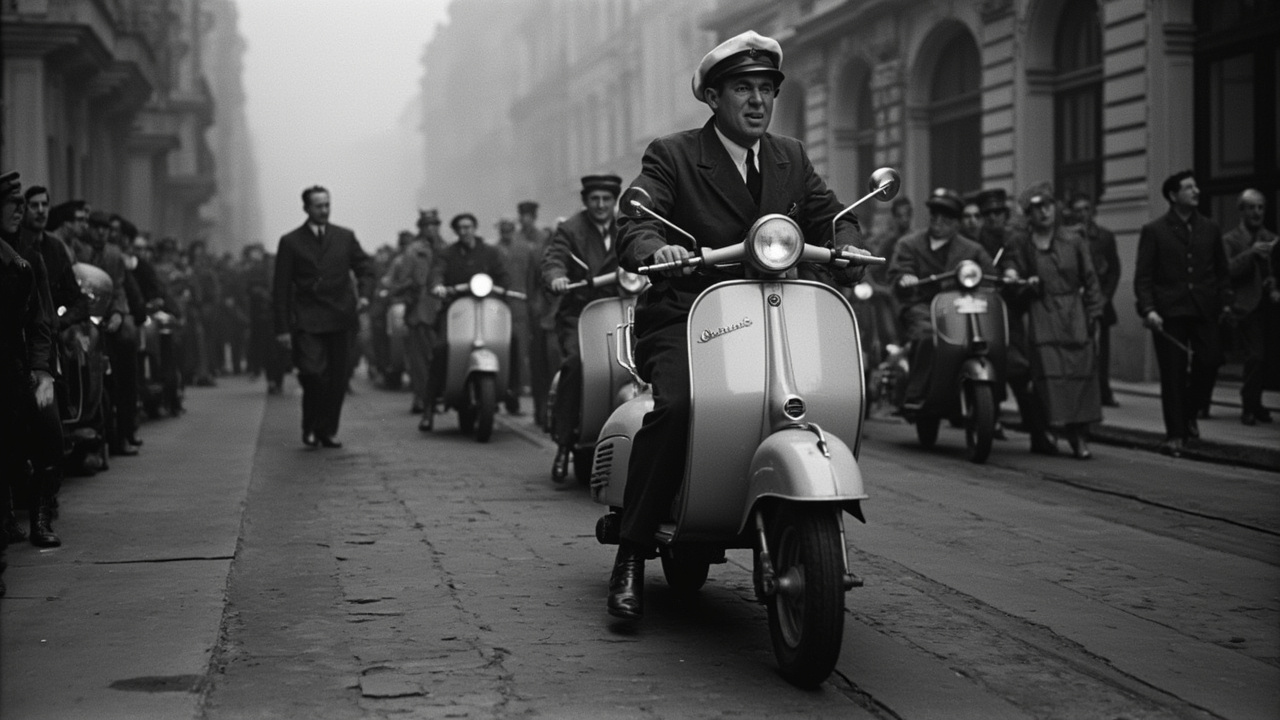
The Postwar Italian Motorcycle Industry
After the end of the Second World War, Italy's motorcycle industry underwent a dramatic transformation. Wartime military production lines gradually shifted to civilian use, and consumer demand for inexpensive personal transportation soared, creating a golden age for the Italian motorcycle industry.
In 1945, Piaggio began rebuilding from the ruins of war. Its factory in Pisa had been badly damaged during the war. Corrado, son of founder Rinaldo Piaggio, took over the company and decided to stop producing aircraft and ships, turning instead to motorcycle manufacturing. In 1946, Piaggio introduced the Vespa125, which became a symbol of the revival of Italy's motorcycle industry. The Vespa was led by designer Corrado D'Andrea, used a single-cylinder four-stroke 125cc engine, and replaced the traditional tubular steel frame with a stamped sheet-steel monocoque structure. This revolutionary construction greatly simplified production, reducing costs and selling price. The name Vespa comes from the Italian word for "wasp," vividly describing its lively acceleration response.
Vespa's success was a microcosm of Italy's postwar economic revival. By the 1950s, annual Vespa production had exceeded one hundred thousand units, making it one of Europe's best-selling motorcycles. Corrado D'Andrea later left Piaggio and founded his own design company, continuing to influence the direction of Italian motorcycle design.
Lambretta was also an important force in popularizing motorcycles in Italy. Founded by Giuseppe Innocenti in 1947, it quickly opened the market with low prices and practical performance. Lambretta used a similar single-cylinder four-stroke engine, but its body design placed greater emphasis on practicality and could be used with a sidecar. Competition between the two companies indirectly promoted progress in Italian motorcycle technology and more accessible pricing.
In the field of larger motorcycles, Gilera quickly recovered after the war. In 1946, Gilera introduced the new GB175 model, using a 175cc single-cylinder engine and offering outstanding performance. More importantly, Gilera began entering international racing in the 1950s, competing for glory with Italian brands such as MV Agusta and Mondial.
MV Agusta was also in a revival phase after the war. This company, whose main business had originally been aircraft engines, restarted motorcycle development after the war. In the 1950s, MV Agusta began to emerge in GP racing and gradually built its image as a high-performance motorcycle manufacturer.
Moto Guzzi was another important participant in Italian motorcycle history. Founded in 1921, this manufacturer introduced several influential models after the war. Its V8 engine development program began in the 1950s, laying a foundation for later racing technology.
The Italian motorcycle industry was characterized by design orientation and market sensitivity. Compared with the engineering cultures of Germany and Britain, Italian manufacturers placed greater emphasis on appearance design and emotional appeal. This quality gave Italian motorcycles a unique brand image in the global market and deeply influenced motorcycle design trends for decades afterward.
However, the golden years of the Italian motorcycle industry did not continue beyond the 1970s. Large-scale exports of Japanese motorcycles presented severe challenges to traditional Italian brands. Scooter manufacturers such as Piaggio and Lambretta underwent restructuring earlier, while heavy-motorcycle brands such as Gilera and MV Agusta chose either to withdraw from the mass market or transform into high-end luxury brands, following a development path very different from Japanese brands.