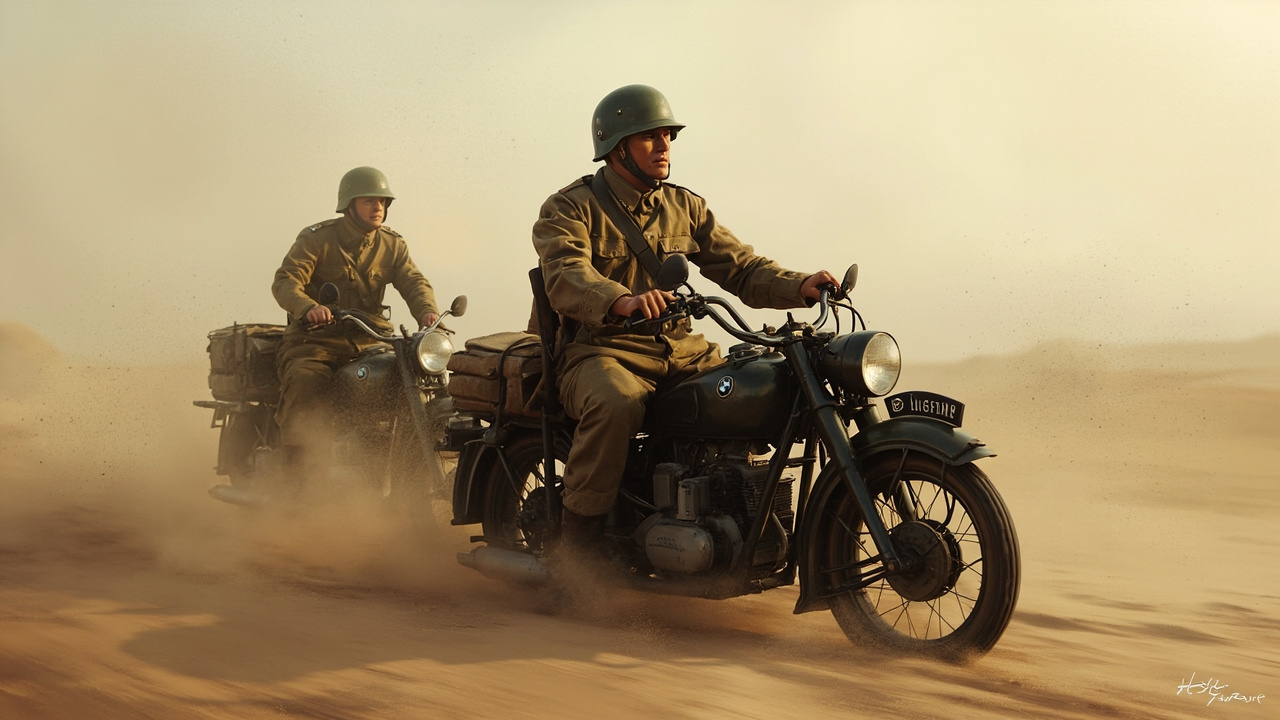
Motorcycles in the Second World War
In September 1939, the Second World War broke out. Compared with the First World War, motorcycles played an even heavier role during the Second World War. This global conflict had a profound impact on the motorcycle industry, leaving lasting marks on technical development, production fluctuations, and the postwar industry structure.
During the Second World War, all belligerent nations used large numbers of motorcycles for military purposes. The German army was one of the forces that used motorcycles most extensively. BMW's R75 sidecar motorcycle became important equipment for German mechanized infantry. The R75 used a 750cc horizontally opposed twin-cylinder engine, shaft drive, and could be fitted with a sidecar machine-gun mount. An R75 with sidecar could carry three people and an MG34 machine gun, giving it impressive firepower projection. Zündapp's KS750 was also a German mainstay. It used the same 750cc engine but a different frame design, and the two models together reached production of tens of thousands of units.
The U.S. military used large numbers of motorcycles during the Second World War, mainly from Harley-Davidson and Indian. Harley-Davidson's WLA model (also known as the Forty-five) became standard equipment for U.S. motorcycle troops. It used a 45-cubic-inch (740cc) V-twin engine, offered excellent reliability, and could operate normally in harsh environments. Large numbers of WLAs were supplied to the Soviet Union under Lend-Lease and became one of the main pieces of equipment for Soviet motorcycle troops. The U.S. military also used some BSA and Matchless motorcycles, supplied by Britain mainly for paratroopers and special units.
On the British side, BSA's M20 and Matchless's G3L were mainstays for the British Army and Allied forces. The 750cc single-cylinder engine was technically old-fashioned, but its simple structure and easy maintenance suited frontline needs. British motorcycle troops were usually organized at divisional level and handled communications and reconnaissance missions.
Japan's motorcycle industry during the Second World War was clearly oriented toward military demand. Although the Japanese Army primarily used bicycles and small trucks, naval landing forces still used small numbers of motorcycles. Hamamatsu Motor, the predecessor of Honda, mainly produced engines and military parts during the war rather than complete motorcycles.
Motorcycle technology during the Second World War saw several important innovations. In lubrication systems, full-function oil pumps became standard equipment, ensuring engines received sufficient lubrication in various attitudes. Electrical systems improved greatly, with alternators gradually replacing DC generators and lighting brightness increasing. In suspension, hydraulic front forks began to spread, improving stability and comfort at high speeds.
After the war, large numbers of surplus military motorcycles entered the civilian market. Europe saw so-called "OPC" (Official Parc Circuit) auctions, where large batches of BMW R75, Zündapp KS750, Harley-Davidson WLA, and other models were sold at low prices. These military motorcycles continued serving across Europe for decades and became important transportation during postwar reconstruction.
The impact of the Second World War on the motorcycle industry was complex. In the short term, military orders saved many manufacturers badly weakened by the Great Depression. But the war also caused severe destruction of production capacity and loss of talent. The German and Japanese motorcycle industries fell into stagnation during the early postwar period and required a long time to recover. Although Italian and British factories suffered less wartime damage, they also had to face role changes and market restructuring after the war.